Specialist online contractor accountancy services
From only £24.50 per month, you'll receive:
- Your own dedicated contractor accountant
- Completion of your accounts and tax returns
- MTD-ready accounting software (Pandle)
- View
Why choose our contractor accountancy services?
We help over 15,000 businesses in the UK to thrive

Your own dedicated accountant
You'll have reliable support from your own accountant, and will always know who you're working with. They'll get to know you, and provide advice tailored to your unique needs.

MTD-ready accounting software
Over 110,000 businesses and contractors around the world use Pandle. You'll receive free access, and our bookkeepers will review your entries regularly to ensure they're accurate.

Unlimited expert advice
You can talk to your contractor accountant as often as you need to. Contact them directly for unlimited support specific to your contracting business, via email, phone, or video call.

Accounts and return included
We'll prepare your annual accounts, and claim every possible expense and allowance when we submit your tax return. That way your business stays up to date and compliant.

Personalised deadline reminders
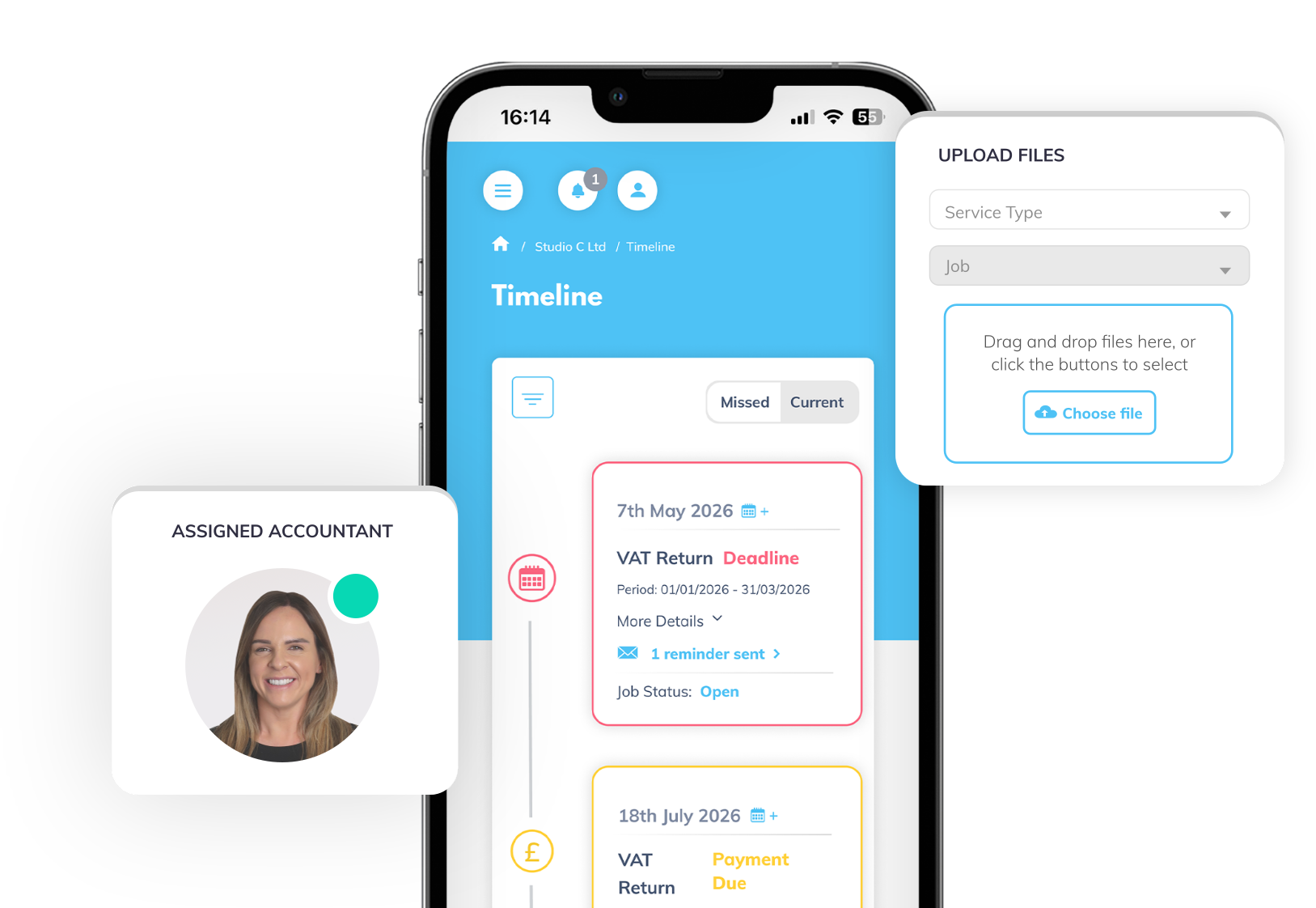
Manage tax and reporting obligations in Client Hub with a tailored timeline of approaching deadlines and reminders, so you know exactly what's happening, and when.

Tax efficiency reviews
Your accountant will carry out annual reviews to make sure your contracting business operates in the most tax efficient way for your circumstances, so you don't miss out.
We will never tie you in to a long-term contract. You are free to leave whenever you
want, we're just confident you won't want to!
We are the largest online accountancy firm in the UK
See what our clients have to say about us
Callum from The Accountancy Partnership recently filed my year-end accounts and made the whole process really straightforward. Callum was excellent throughout - clear, helpful and efficient, and he made everything feel simple from start to finish. A very smooth experience and I’d happily recommend him to anyone looking for reliable accountancy support.
Ben Chetham
As a first-year sole trader, I was a little unsure about the accounting side of things, but James has been incredibly helpful throughout the whole process. He is very knowledgeable, patient, and took the time to guide me through everything, making it much less stressful than I expected.
Hayley Crean
Kieran McCann provided outstanding support in helping me file my corporation tax return within an extremely tight timeframe. The last-minute situation was entirely my own fault, but Kieran remained calm, professional, and incredibly responsive throughout the process. Thanks to his efficiency and dedication, we managed to meet the deadline and avoid what would likely have been a fine. He was always responsible, supportive, and available whenever I needed guidance.
Aurore Nguyen
Your Client Hub
All your account details, documents, and deadlines in one secure place. Never miss a submission again.
How easy is it to join?
We can have you all set up in just three simple steps…

Get a quote
Get your instant online quote to find out how much you'll be paying.

Register your business
Fill out our simple online registration form. It’s only short, we promise.

Receive a warm welcome
We’ll set up your Client Hub account and introduce you to your accountant.
Say hello to some of our friendly, in-house accountants
Approachable experts who are always happy to talk things through

Jack Whitehead AATQB
Accounts Semi-Senior
Qualifications
I graduated from The University of Sheffield with a degree in Astrophysics.
Hobbies
My hobbies include going for meals with my girlfriend, socialising with friends, and writing music – (and spending way too much money on guitars).
Read Staff Spotlight
Sophie Kearns
Accounts Semi-Senior
Qualifications
Level 2 & 3 AAT qualified
Hobbies
I enjoy spending time with my family and friends, staying active, cooking, and travelling.
Read Staff Spotlight
Ben Salisbury
Accounts Semi-Senior
Qualifications
I am currently in the process of completing my ACCA exams.
Experience
I graduated from Liverpool John Moores University with a first in July 2023.
Hobbies
I enjoy football, going to the gym and playing music, particularly guitar.
Read Staff SpotlightUnsure how to structure your contracting business?
Contracting describes the way you work for clients, but it isn’t a legal structure in its own right. You’ll need to decide how to register and run your business, but it can be tricky working out whether to use an umbrella company, or trade through your own limited company or as a sole trader. You might even decide to set up using one type of structure, and then switch to something else as the business grows.
Choosing which option is right for you depends on your own personal circumstances and preferences, but we can talk you through your options and how they might affect you. Our friendly advisors are always on hand to help you make decisions for your business. You can get in touch using live chat or by phoning us on 020 3355 4047.

Moving to us from another accountant?
Switching your contracting business to a new accountant doesn’t need to give you sleepless nights – if you have the right support to manage the process! Our team take care of every step, starting with contacting your previous accountant.
We’ll liaise with your old provider directly to make sure all your records are transferred, and let HMRC know that we’re acting on your behalf. You won’t need to worry about the transition, and can focus on getting to know your new dedicated accountant.

What accounting services do contractors need?
Every contractor must submit tax returns for HMRC to work out how much tax they owe. For example, if you run a limited company you’ll submit a Company Tax Return, and as a sole trader you’ll use either a Self Assessment or MTD Income Tax return depending on how much you make. It’s why we include a full set of financial accounts and the appropriate tax return in your fee as standard.
You might also need to register for the Construction Industry Scheme and send CIS Returns if you pay subcontractors for construction work. It can be confusing, which is why we’re here to help! You can add this service to your standard package starting from £30.00.

Video call your accountant
Schedule video calls with your dedicated accountant for personalised, unlimited advice tailored to your business.


Additional accounting services for contractors
Your business is unique, so the sort of support you need as a contractor can vary. You can add or remove additional services such as VAT returns, payroll, CIS Returns, or bookkeeping, when you need them, for low monthly fees.

CIS Returns
CIS Returns and subcontractor admin by your own assigned accountant.

VAT Returns
Everything your company needs for VAT registration and returns.

Bookkeeping
Tailored bookkeeping services provided by your own dedicated bookkeeper.

MTD IT Updates
Quarterly MTD Income Tax updated prepared and sent by your accountant.
Looking for more information about operating a contractor business?
Check out our free resources for contractors to help things run smoothly

Contractor Guide
Thinking about becoming a contractor? This guide covers all the factors you will need to consider.
5 minutes
IR35 Guide
Do you understand the implications of IR35 for your business? If not, then this guide is perfect for you.
7 minutes
Construction Industry Scheme (CIS) Guide
Understand your tax obligations and how to register for CIS as a contractor or sub-contractor working in construction.
5 minutes
FAQs
Contractor FAQs
We include free access to Pandle Pro, but you can use any accounting software. If you do use Pandle, our bookkeeping team will check your records at no extra cost.
This entirely depends on your circumstances. There are lots of factors to take into consideration, like how much personal liability you’re comfortable with, other income you might get from different sources, and whether there will be anyone else involved in the business. This is something we can help you with. In the meantime, this article will help you get started!
Umbrella companies act a bit like temping agencies for contractors or other temporary workers. Rather than invoicing your client directly, you’ll be employed by the umbrella agency, which will pay your wages and make any deductions for tax and National Insurance. They’ll then collect payment from your client.
IR35 was introduced to minimise the risk of self-employed people working through their own limited company as a way to avoid tax. The very short version is that IR35 affects how contractors pay tax if they work for a client through their own limited company, when they would otherwise be working for them as an employee if the company didn’t exist. The rules can be a bit confusing, so your accountant can go over this if you need help.
This depends on several factors, such as whether you run your contracting business as a sole trader or a limited company, how much you earn, and any other income you might get! Your accountant will go over the different options so you have a better idea of what to expect. You can also use our free online tax calculator to estimate how much tax you might need to pay.
Yes, absolutely. You’ll be assigned your own dedicated accountant, who you can contact directly. You’ll also have contact details and direct access to their buddy accountant in case yours is ever off for any reason, but they’ll always let you know about planned absences in advance.
You're in good hands
When you trust us with your accounts, you can have complete confidence that we know what we’re doing. Our accountants have a wide range of qualifications and accreditations from trusted professional bodies such as the AAT, ICPA and ACCA.