Capital Gains Tax (CGT) is a tax on the profit (or gain) you make when ‘disposing’ of an asset which you own. Disposal of an asset usually means it’s been sold, but it can also mean giving it away, swapping it for something else, or receiving compensation for its loss (such as an insurance payout).
It normally applies to business structures where there’s no legal distinction between you or your business. So, sole traders and partnerships may be liable to pay Capital Gains Tax – whereas an incorporated business (like a limited company) will pay Corporation Tax on any profit it makes when disposing of a business asset.
We know Capital Gains Tax can get a bit complicated, so in this post we’ll explain the basics and give you some simple scenarios to show you how it works.
**Updated for 2026/27
How much is Capital Gains Tax?
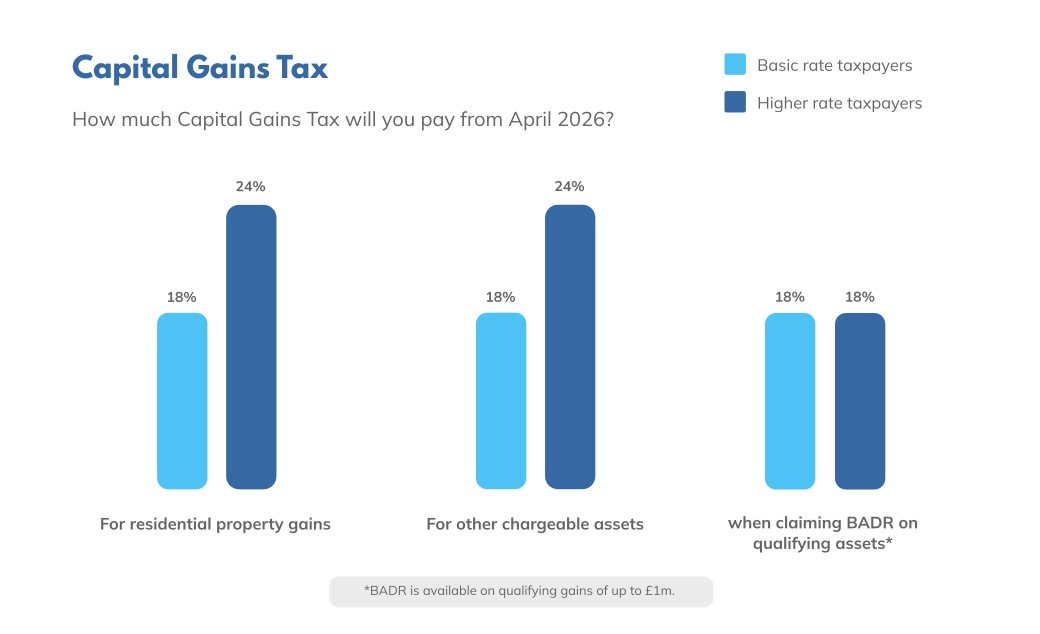
The rates and thresholds will sometimes change from one tax year to the next. The table and infographic below show the current rates (or you can use our online calculator to estimate your bill).
| Rate of CGT | |||
| Asset Type | Type of Taxpayer | 2025/26
| 2026/27
| |
| Most chargeable assets | Basic | 18% | 18% |
| Higher | 24% | 24% | |
| Residential property | Basic | 18% | 18% |
| Higher | 24% | 24% | |
| Assets qualifying for BADR | 14% | 18% | |
Capital Gains Tax for individuals
Most of us won’t need to think about Capital Gains Tax that often, but it might cross your radar if you dispose of a valuable asset. The most frequent questions around Capital Gains Tax relate to houses and cars but you might also encounter it if you dabble in cryptocurrency.
Will I need to pay Capital Gains Tax when I sell my house?
Property prices have risen rather dramatically over the years, so the sale of your house might mean a very substantial gain indeed. The good news is you won’t normally need to pay Capital Gains Tax on property as long as:
- It’s your only home, which you’ve lived in as your main residence for all the time you’ve owned it
- You haven’t let part of it out (not including having a lodger)
- You haven’t used part of your home exclusively for business purposes (using a room as a temporary or occasional office does not count, whereas having a dedicated garden office might)
- The grounds, including all buildings, are less than 5,000 square metres (just under an acre) in total
- You didn’t buy it with the aim of making a gain
What assets are exempt from Capital Gains Tax?
Not everything you sell is subject to Capital Gains Tax. For instance, certain assets with a life expectancy of 50 years or less (known as wasting assets) are generally exempt. Since these items are unlikely to significantly increase in value over time, any profit you make when selling them is usually free from Capital Gains Tax. They include things like:
- Machinery
- Furniture
- Natural resources (like coal and natural gas)
- Cars – but only if they’re not used for business
This goes for classic cars too. So, if you have an E-type sitting in the garage, you can decide to sell it and release the massive gain it has made over the last few years without getting clobbered by tax. The rules are a bit more complicated if you decide to sell the actual garage!
Gifts, investments, and Capital Gains Tax
Things like gifts or investments are also usually exempt from Capital Gains Tax, including:
- Gifts to a registered charity
- Gifts to a spouse or civil partner
- Investments in PEPs or ISAs
- UK government gilts and Premium Bonds
- Competition, betting, pools, or lottery winnings
Be aware: Unless it is to your spouse or a charity, giving something away will be treated exactly like selling it and you’ll need to declare its value at the time of the disposal.
Capital Gains Tax for businesses
Your business won’t pay Capital Gains Tax if it operates as a limited company. Instead, gains are treated like any other profit and subject to Corporation Tax. It’s a bit different if you operate as a sole trader or partnership.
Without any legal distinction between you and your business, any gains it makes are considered ‘yours’, so you’ll need to include them as part of your personal tax return.
Whilst a sole trader will be fully liable for the gains they make, an individual partner in a partnership only needs to work out their share of any gains in proportion to their share of the partnership.
It’s worth asking for advice if you’re not sure, because Capital Gains Tax is a complex area for businesses. For example, a business set up to invest in fine art will pay tax differently to one that just happens to make a gain selling a painting it had on the office wall.
If you use your capital gains to buy another business asset
If you make a ‘capital gain’ because you’ve disposed of a business asset, but then use some or all of that amount to buy another business asset, you might be able to claim Business Asset Rollover Relief to delay paying tax on the gain.
Different type of assets in a business
When we talk about Capital Gains Tax for businesses, it’s important to understand what the term asset means in the context of running a business. There are two types of assets a business might use:
- Current assets
- Fixed assets
Current assets
The first category refers to assets you use for trading, and includes things like stock you sell to customers, raw materials to create products, or working capital (the ‘liquid’ funds available for you to meet your short-term obligations).
In accounting terms, these are seen as things which will be used up within the next 12 months, so although they are assets, they are short-term in nature.
From a taxation point of view, these short-term assets form part of the trading of the business. If the business makes a profit when it comes to sell them, then it will pay tax in the normal way.
Fixed assets
These are likely to be around for more than a year, and it is this category which is liable for Capital Gains Tax.
It’s useful to remember that a gain doesn’t have to be made on a physical thing. Capital Gains Tax can also be payable on intangible items like brands, or trademarks and patents.
Working out your gain for Capital Gains Tax
Capital Gains Tax is worked out based on the profit you make, rather than on the full amount of the disposal. In plain terms, it’s the difference between what the asset was worth when you acquired it, and when you disposed of it.
For example, if you paid advertising fees in order to sell the asset, or you spent money to improve it beyond normal repairs, you can deduct these costs from the gain you make.
Working out the value gets a bit more complicated if you dispose of assets known as a ‘chattel set’, where similar items can be combined to form a set – such as individual pieces in a chess set. Always speak to an accountant if you get stuck!
Is there a tax-free allowance for Capital Gains Tax?
It’s not all doom and gloom, and there is a tax-free allowance available before you start paying Capital Gains Tax. Known as the Annual Exempt Amount, the allowance you’re entitled to depends on whether you’re an individual or a trustee. We show the allowance for both 2025/26 and for 2026/27 to help you keep track of what’s coming up for your next tax return, as well as the year after!
| 2025/26 | 2026/27 | |
| Individuals | £3,000 | £3,000 |
| Trustees | £1,500 | £1,500 |
So, if you’re an individual and the total of all your gains is less than £3,000 in 2026/27, then you won’t pay any Capital Gains Tax at all.
If all your gains for the year total £10,000, then you’ll only pay Capital Gains Tax on the portion of the gain which is over the allowance (in this example, £7,000 is taxable). And never forget! We’re looking at the gain here, and not the sale price.
Do I need to report capital gains below the allowance?
No, you only need to report and pay Capital Gains Tax on taxable gains above the allowance.
What if I make a loss selling an asset?
If you sell an asset for a fair, genuine price, and you lose money on the sale, you may be able to use that ‘capital loss’ to reduce your taxable gains from other sales.
HMRC are strict on this though, so you can’t claim losses if:
- The asset was given or sold to a spouse or civil partner (because there normally wouldn’t be any CGT on this disposal anyway)
- You sold the asset to a ‘connected person’ (for example your business partner or your son-in-law)
- The asset you’ve sold is a non-chargeable asset (so it’s not eligible for CGT)
Capital Gains Tax relief for businesses
There are CGT relief schemes available, such as Business Asset Disposal Relief, if you need to pay Capital Gains Tax on gains you make through your business. The eligibility criteria and the level of relief available does vary, so it’s always worth getting advice!
How much Capital Gains Tax will I pay?
The rate of Capital Gains Tax you pay is linked to the total income you get during a tax year, because the rate you pay is determined by adding your gain to your other taxable income. The rate also depends on whether the disposal was for property or something else.
For example
You receive a salary from your employer, and this uses up part of your basic income tax band. You sell an asset and make a gain, so this capital gain is stacked up on top of your other income.
- Part of the gain falls within the remaining unused part of your basic rate band, so this chunk is taxed at the basic CGT rate
- The gain pushes you over into the higher rate band, so that part of your gain is taxed at the higher CGT rate
| Rate of CGT | |||
| Asset Type | Type of Taxpayer | 2025/26
| 2026/27
| |
| Most chargeable assets | Basic | 18% | 18% |
| Higher | 24% | 24% | |
| Residential property | Basic | 18% | 18% |
| Higher | 24% | 24% | |
| Assets qualifying for BADR | 14% | 18% | |
Working out Capital Gains Tax
This may all seem a little theoretical, so we thought it would be helpful to include an example. The starting point is to work out your gain.
This is simply the selling price, minus the cost of acquiring the asset. Remember, you are also allowed to offset any costs incurred selling, purchasing, or improving the asset in the meantime.
| Step | Running balance |
| Proceeds from the disposal What did John get in return for disposing of the asset? In this example, it’s the price he sold the painting for. |
£30,000 |
| Total costs and expenses What John spent on the asset.
|
£13,000 |
| Total gain The proceeds from the disposal, minus the total costs. |
£17,000 |
| Total taxable gain The total gain, minus the Annual Exempt Amount, which in 2026/27 is £3,000 |
£14,000 |
| John’s income for the tax year In this case it’s the taxable gain he made, plus his salary.
|
£36,000 |
| The rate of Capital Gains Tax To work out which rate of Capital Gains Tax to use, remember:
|
18% |
| Capital Gains Tax to pay The total taxable gain multiplied by the rate of Capital Gains Tax |
£2,520 |
What if multiple people own an asset?
If more than one person owns the asset, then the proceeds are split by their particular shares.
For example
Three members of a family buy a painting between them for £1,000, and sell it for £7,000.
The gain would normally be £6,000 and therefore over the limit, but because it’s owned equally by 3 people, the proceeds are divided equally between them.
Each individual gains £2,000 from the sale, and as a result they’re under the limit.
Do I still need to report Capital Gains if I don’t owe any tax?
If you’re registered for Self Assessment then you’ll need to mention your gains in your tax return. If you’re not registered, you won’t need to report your gains as long as the total gains you make in a year are below the £3,000 Annual Exempt Amount, and the total amount you receive from these transactions is less than £50,000.
Tax is complicated, which is why it’s useful to chat with someone who knows their way around the subject. Learn more about our online accounting services for businesses, and make the most of any tax allowances and reliefs available. Call 020 3355 4047 or get an instant online quote.
Want to learn more?
Subscribe to our newsletter to get accounting tips like this right to your inbox